What Did a Medieval Blacksmith’s Workshop Actually Smell Like?
If you stepped into a working blacksmith’s shop in medieval England, it probably would not smell like something you would want burning in your living room. The air would have been heavy with smoke from the forge. There would have been ash, scorched wood, hot iron, scale and slag from the metalworking process, worn leather, timber, and probably more than a little sweat. It was a working shop, after all, not a perfumery.
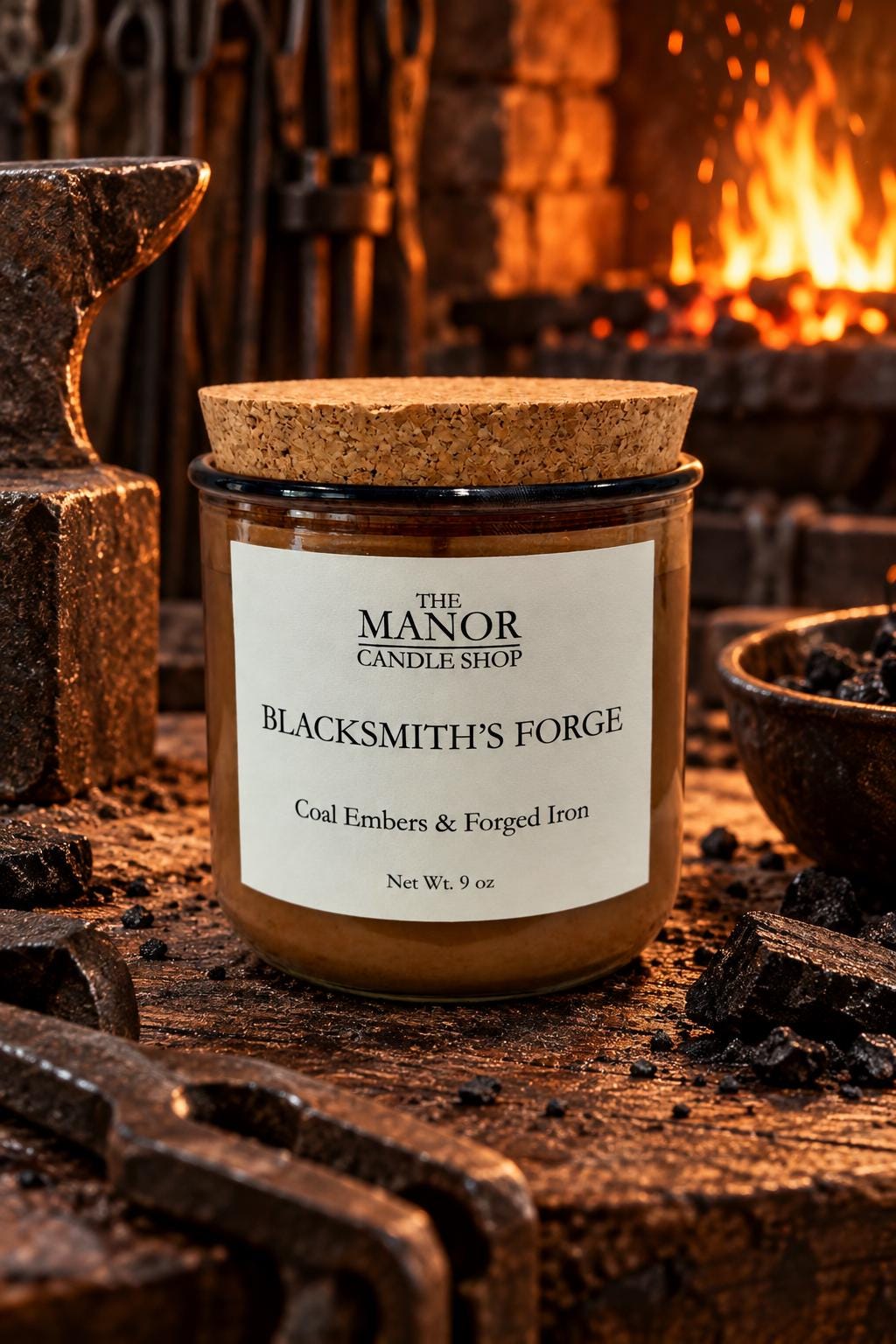
So I am very aware that a medieval blacksmith’s forge did not smell nearly as good as my Blacksmith’s Forge candle does. But that was never really the point. The goal was to capture the feeling of walking into a medieval smithy and translate the parts of that environment into something you might actually want your home to smell like.
The Medieval Blacksmith Behind the Candle
Blacksmithing has been in the back of my mind for years. In the historical fiction novel I have been working on for the last couple of years, my main character comes from a line of blacksmiths.
That choice was, of course, influenced by the countless hours I have spent playing Kingdom Come: Deliverance, which I will unapologetically call the best medieval video game ever made.
Between writing historical fiction and spending far too much time wandering virtual medieval villages, I began thinking about these places not only in terms of how they looked, but how they would have smelled.
You might hear a medieval blacksmith’s workshop before you saw it. The ringing of hammer against iron, the roar of the hearth when the bellows fed it air, and then, as you stepped closer, the smoke, heat, ash, timber and iron of the workshop itself. In my novel, I describe the village blacksmith as having an acrid tang from the smoke and the sulfuric sting of impurities burning away from the fire and metal.
Historically evocative? Absolutely. A delightful candle fragrance? Not particularly.
Turning a Medieval Forge Into a Fragrance
That created an interesting problem when I began developing Blacksmith’s Forge for The Manor Candle Shop. I did not want to make something that literally smelled like industrial smoke and burning metal, but I also did not want to create a pleasant modern fragrance, put the words Blacksmith’s Forge on the vessel and call it medieval.
There had to be something connecting the fragrance to the place.
I started with firewood as the anchor. More than anything else, this is what I imagine would have defined the air around a working forge. Not just smoke, but the warm, dry smell of a fire that had been burning for hours. Heat and ash. Firewood gave me a way to capture that familiar warmth without pushing the candle into something harsher or overly smoky.
Next came leather, representing the aprons, gloves, straps and equipment associated with the traditional blacksmith. It adds a worn, rugged quality without overpowering the fragrance.
Then I needed something to represent the iron itself. Obviously, I could not simply add the smell of hot forged iron to a candle, so black pepper became my interpretation of the metallic note. Its dry, sharp character cuts through the warmer woods and smoke and gives the fragrance something harder underneath.
Finally, birch and cedar give character to the workshop itself, representing the tools, beams, walls, workbenches and rough timber surrounding the forge.
Together, the idea became simple: Fire. Wood. Leather. Iron. Smoke. Not a literal recreation of every smell that would have existed inside a medieval blacksmith’s shop, but an interpretation of the parts worth remembering.
Then a Real Blacksmith Put It to the Test
After several early variations of Blacksmith’s Forge, I gave a sample candle to one of my best friends. His father is a blacksmith by trade, so I was particularly interested in what his family would think. Unlike me, they actually knew what a working blacksmith’s shop smelled like.
At one point, my friend asked his wife what she thought the unlabeled candle smelled like. She closed her eyes for a moment and said she could not pinpoint a particular fragrance, but that it reminded her of his father’s shop. That comment meant more to me than if she had simply said the candle smelled good, because that was exactly what I had been trying to accomplish.
Creating a Place Instead of Just a Scent
That experience helped solidify what I wanted The Manor Candle Shop to be. I do not want to take an ordinary modern fragrance, give it a medieval-sounding name and put a fantasy label on the vessel. I want the fragrance itself to help create the place. When you light Blacksmith’s Forge, I want you to imagine standing near the open door of a medieval smithy while a hammer rings against an anvil somewhere inside.
Of course, the real medieval world was dirty, smoky and frequently unpleasant smelling. I am not trying to recreate all of that. I am trying to capture the part that survives in the imagination: the warm fire, old timber, worn leather, smoke hanging faintly in the air, and somewhere beneath it all, the suggestion of hot iron being shaped over the anvil.
That is Blacksmith’s Forge. Not necessarily what a medieval blacksmith’s workshop smelled like, but perhaps what we wish it did.